How Are Mari Djata (Sundiata an His Family Mistreated After His Father's Death?
| Mansa Sundiata Keita | |||||
|---|---|---|---|---|---|
| Founder and Emperor of Majestic Republic of mali | |||||
| Reign | c. 1235 – c. 1255[i] | ||||
| Coronation | Crowned Mansa after The Battle of Kirina: c. 1235 | ||||
| Predecessor | Naré Maghann Konaté and Dankaran Touman both as Faamas (Kings in Mandinka language – pre-Imperial Mali. As a Mansa (King of Kings), preceded by none). | ||||
| Heir-apparent | Mansa Uli I | ||||
| Born | c. 1217[2] Dakadjalan, part of nowadays-solar day Republic of mali[3] | ||||
| Died | c. 1255 (aged c. 37–38) | ||||
| Result | Mansa Wali Keita Mansa Ouati Keita Mansa Khalifa Keita Mansa Sundiata Keita likewise had daughters not merely sons. | ||||
| |||||
| House | The Royal Business firm of Keita | ||||
| Begetter | Naré Maghann Konaté | ||||
| Female parent | Sukulung Conté | ||||
| Religion | Prevailing view: Traditional African faith[4] [5] [vi] others claim Muslim[7] [8] | ||||
Sundiata Keita (Mandinka, Malinke: [sʊndʒæta keɪta]) (c. 1217 – c. 1255[ix]) (also known as Manding Diara, Lion of Republic of mali, Sogolon Djata, son of Sogolon, Nare Maghan and Sogo Sogo Simbon Salaba) was a prince and founder of the Mali Empire. The Malian ruler Mansa Musa, who made a pilgrimage to Mecca, was his peachy-nephew.[10] [11]
Written sources augment the Mande oral histories, with the Moroccan traveller Muhammad ibn Battúta (1304–1368) and the Tunisian historian ibn Khaldun (1332–1406) both having travelled to Mali in the century after Sundiata's decease, and providing contained verification of his existence. The semi-historical but legendary Epic of Sundiata by the Malinké/Maninka people centers on his life. The epic poem is primarily known through oral tradition, transmitted by generations of Maninka griots (djeli or jeliw).[12] The Manden Charter issued during his reign is listed by UNESCO as 1 of an intangible cultural heritage.[thirteen]
Epic of Sundiata [edit]

The oral traditions relating to Sundiata Keita were passed down generation afterwards generation by the local griots (djeli or jeliw), until somewhen their stories were put into writing. Sundiata was the son of Naré Maghann Konaté (variation: Maghan Konfara) and Sogolon Condé (variations: "Sogolon Kolonkan" or "Sogolon Kédjou", the daughter of the "buffalo woman", so-called because of her ugliness and hunchback).[16] Sundiata was bedridden from babyhood and his female parent (Sogolon) was the subject of ridicule among her co-wives. She was constantly teased and ridiculed openly for her son's disability. This significantly affected Sundiata and he was determined to do everything he possibly could in order to walk like his peers. Through this determination, he one solar day miraculously got up and walked. Amidst his peers, he became a leader. His paternal one-half-brother, Dankaran Touman, and Dankaran's mother, Sassouma Bereté, were cruel and resentful of Sundiata and his female parent. Their cruelty escalated after the death of Naré Maghann (the king and male parent of Sundiata). To escape persecution and threats on her son's life, Sogolon took her children, Sundiata and his sisters, into exile. This exile lasted for many years and took them to unlike countries within the Ghana Empire and eventually to Mema, where the rex of Mema granted them asylum. Sundiata was admired past the King of Mema for his courage and tenacity. As such, he was given a senior position inside the kingdom. When King Soumaoro Kanté of Sosso conquered the Mandinka people, messengers were sent to get and look for Sogolon and her children, as Sundiata was destined to be a great leader co-ordinate to prophecy. Upon finding him in Mema, they persuaded him to come dorsum in club to liberate the Mandinkas and their homeland. On his return, he was accompanied past an army given to him by the King of Mema. The warlords of Mali at the time who were his age grouping included: Tabon Wana, Kamadia Kamara (or Kamadia Camara), Faony Condé, Siara Kuman Konaté and Tiramakhan Traore (many variations: "Trimaghan" or "Tiramaghan", the future conquistador of Kaabu). Information technology was on the patently of Siby (var: Sibi) where they formed a pact brotherhood in order to liberate their country and people from the powerful Sosso king. At The Boxing of Kirina, Sundiata and his allies defeated the Sosso king, and he became the first Emperor of the Mali Empire. He was the first of the Mandinka line of kings to adopt the royal title Mansa (king or emperor in the Mandinka language).[17] [18] [19] [20] [21] [22]
The Mandinka epic does not give u.s. dates, merely Arab and North African writers who visited the area nigh a century subsequently the epic's events documented on paper some of the information, including dates and a genealogy. Conversely, the written sources left out other pieces of information that the oral tradition includes.[23]
- Sogolon Djata
- Sundjata Keyita
- Mari Djata or "Mārī-Djāta" (co-ordinate to Ibn Khaldun in the late 14th century)[24]
- The Lion King[25]
The proper English spelling of Sundiata's name is Sunjata, pronounced soon-jah-ta, approaching the bodily pronunciation in the original Mandinka. The name Sogolon derives from his female parent and Jata means lion. It is the traditional mode of praising someone in some West African societies (The gambia, Senegal, Mali and Guinea in detail). The name Sundiata praises him through his mother which means "the lion of Sogolon" or "Sogolon'southward lion". The name Jata derives from Jara (panthera leo). Jara and many of its variations such as jata, jala or jada are just regional variations, from Gambia, Guinea or Mali, for instance. Sundiata's name is thus a derivation of his mother'south name Sogolon (Son or its variation Sun) and Jata (lion).[26] [27]
Surname (Keita or Konaté?) [edit]
Some Bambaras and Mandinkas take proposed that the proper name Keita really ways inheritor (heir-apparent) in the Mandinka language, and that Sundiata's real surname is Konaté (French spelling in Republic of mali) or Konateh, variations: Konate, Conateh (English spelling in the Gambia where the Mandinkas make up the largest ethnic group). Information technology is proposed that Sundiata Keita'south father, Naré Maghann Konaté, took the real family unit name Konaté while his successors were "Keitas in waiting" (heirs to the throne).[26] The proper noun Keita is a clan proper name rather than a surname.[28] Although in some Due west African societies a clan can be like to the family unit name (see Joof family or the Gitten Clan), such similarities do not exist between the names Keita and Konaté. Both points of contention hold that Keita is non a existent surname, but rather a royal proper noun, in spite of the fact that Sundiata is referred to every bit Sundiata Keita in many scholarly works. At present, at that place is no consensus amongst the scholars regarding the name Sundiata Konaté.
Boxing of Kirina [edit]
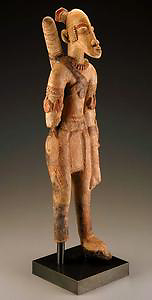
Terracotta archer effigy from Mali (13th-15th century), with a quiver on his back. The bow and quiver of arrows were the symbols of power in Imperial Republic of mali.[29]
Delafosse previously proposed that, Soumaoro Kanté's grandfather with the help of his army and the Sosso nobility of Kaniaga captured what was left of the sacked Ghana Empire, and by 1180, Diara Kanté (var: Jara Kante), Soumaoro'southward father gained control of Koumbi Saleh, dethroned a Muslim dynasty and continued the Diarisso Dynasty (variation: Jariso or Jarisso) whose son (Soumaoro) went on to succeed him and launched an offensive against the Mandinkas.[xxx] [31] Delafosse's original piece of work has been refuted and discarded by many scholars including Monteil, Cornevin, etc. There was no Diara Kanté in the oral sources. That was an addition past Delafosee which was contrary to the original sources.[32] The consensus is, in c. 1235, Sundiata who had survived one of Soumaoro's earlier raids went to state of war with the help of his allies against Rex Soumaoro of Sosso. Although a valiant warrior, Soumaoro was defeated at The Battle of Kirina (c. 1235).[33] Soumaoro is regarded equally one of the true champions of the Traditional African religion. According to Fyle, Soumaoro was the inventor of the balafon and the dan (a iv-cord guitar used past the hunters and griots).[34] After his victory at Kirina, Sundiata took command of the sometime conquered states of the Sosso and appropriated privileges amidst those who participated in the defeat of Soumaoro. The former allies of Soumaoro were as well afterwards defeated, in particular the rex of Jolof. Serer oral tradition speaks of a Serer rex of Jolof, involved in the occult (just as Soumaoro), who was later defeated past Tiramakhan Traore (i of the generals of Sundiata) after Sundiata sent his men to buy horses in Jolof. Information technology is reported that, when Sundiata sent his men to Jolof to buy horses in a caravan loaded with gold, the rex of Jolof took all the golden and horses – known among some as "the robbery of the horses". In a revenge attack, Sundiata sent his general to Jolof to electrocute the male monarch.[35] It is believed that, information technology was probably this king of Jolof (known as Mansa Jolofing or Jolofing Mansa) who sided with Soumaoro at The Battle of Kirina[36] and perchance belongs to the Ngom Dynasty of Jolof, the predecessors of the Diaw and Ndiaye Dynasties of Jolof.[37] Now, little is known nigh the Ngom Dynasty of Jolof.
Niane has avant-garde the merits that, the Jolofing Mansa sided with Sumaguru [or Soumaoro] considering "like him, he was hostile to Islam." He went on to land that:
- "He [the King of Jolof] confiscated Diata's [Sundiata's] horses and sent him a skin, saying that he should brand shoes out of it since he was neither a hunter nor a rex worthy to mount a horse." [38]
Organized religion [edit]
In his piece in the General History of Africa, Book 4, p. 133, Djibril Tamsir Niane alludes to Sundiata existence a Muslim.[38] According to Fage, in that location is zilch in the original epos that supports the claim. Sundiata is regarded as a great hunter and magician whose subjects predominantly adhered to traditional beliefs, every bit did Sundiata.[4] [5] [6] Still, some of Sundiata's successors were Muslim, with Mansa Musa Keita existence i of the most widely known.[39] The explorer Ibn Battuta, who visited Republic of mali during the reign of Sundiata'due south cracking-nephew Suleyman, claimed that Mansa Musa's grandfather was named Sariq Jata and had converted to Islam.[40] This may be a reference to Sundiata, though if so Ibn Battuta was plainly mistaken nearly the genealogy, equally Musa'southward granddad was Sundiata'due south brother Mande Bory. Other medieval Arabic sources merits that a ruler earlier Sundiata named Barmandana was the first ruler of Mali to convert to Islam.
Some Muslim griots later added to the epic of Sundiata by challenge that Sundiata has "an ancestral origin among the companions of Muhammad in Mecca" (namely, Bilal Ibn Rabah)[41] and speaks of himself as a successor to Dhu al-Qarnayn, a conqueror and king mentioned in the Quran, commonly regarded as a reference to Alexander the Great[ dubious ].[42] Claims such as these are referred to by scholars like Grand. Wesley Johnson equally nil more than "Islamic legitimacy" - in African countries where Islam is now the predominant religion such as Senegal, and where Muslim griots effort to link historical African figures to the prophet Muhammad either through a line of descent or by claiming that the ancestor of the historical effigy belonged to Muhammad's tribe or was one of his followers (an attempt to afar them from their traditional African religious past).[43] [44] Although Sundiata was not a Muslim, it is clear that the original ballsy of Sundiata was later affected by what Ralph Austen calls "Islamicate" culture—that is, the integration of Islamic and Arab culture.[42]
Royal Mali [edit]

After his victory at Kirina, Mansa Sundiata established his majuscule at Niani, almost the present-day Malian border with Guinea.[46] Assisted past his generals, Tiramakhan beingness one of the well-nigh prominent, he went on to conquer other states. The lands of the old Ghana Empire were conquered. The king of Jolof was defeated by Tiramakhan and his kingdom reduced to a vassal land. After defeating the erstwhile marry of Soumaoro, Tiramakhan ventured deep into present-day Senegal, the Gambia and Guinea Bissau and conquered them. Tiramakhan was responsible for the conquest of the Senegambia.[47] In Kaabu (part of nowadays-day Guinea Bissau), he defeated the final great Bainuk rex (Male monarch Kikikor) and annexed his state. The corking Kikikor was killed and his kingdom was renamed Kaabu.[48] [49] Sundiata was responsible for the conquest of Diafunu and Kita.[47] Although the conquered states were answerable to the Mansa (king) of Mali, Sundiata was not an absolute monarch despite what the title implies. Though he probably wielded popular authorization, the Mali Empire was reportedly run like a federation with each tribe having a master representative at the court.[l] The first tribes were Mandinka clans of Traore, Kamara, Koroma, Konde (or Conde), and of course Keita. The Great Gbara Assembly was in accuse of checking the Mansa'southward power, enforcing his edicts among their people, and selecting the successor (usually the Mansa'due south son, brother or sis's son).[51] The Empire flourished from the 13th to the belatedly 14th century[12] simply began to refuse as some vassal states threw away the yoke of Mali and regained their independence. Some of these onetime vassals went on to course empires of their own.[52]
Decease [edit]
The generally accustomed death twelvemonth of Mansa Sundiata Keita is c. 1255.[6] [53] Nevertheless, there is very little information regarding his cause of expiry. Not only are in that location dissimilar versions, mainly mod, but Mandinka tradition forbids disclosing the burying basis of their great kings.[54] [55] According to some, he died of drowning while trying to cross the Sankarani River, near Niani.[54] [56] If one is to believe Delafosse, he was "accidentally killed by an arrow during a ceremony."[57] Others have maintained that he was assassinated at a public sit-in, also known equally a Gitten.[56] At present, the generally accepted crusade of death is drowning in the Sankarani River, where a shrine that bears his proper noun still remains today (Sundiata-dun meaning Sundiata's deep water).[54] His three sons (Mansa Wali Keita, Mansa Ouati Keita and Mansa Khalifa Keita) went on to succeed him as Mansas of the Empire. The famous and notably ostentatious[58] West African ruler Mansa Musa was Sundiata Keita's neat-nephew.[10]
Legacy [edit]
A potent ground forces was a major contributor to the success of Imperial Mali during the reign of Mansa Sundiata Keita.[47] Credit to Republic of mali's conquests cannot all be attributed to Sundiata Keita but equally shared amongst his generals, and in this, Tiramakhan Traore stood out as one of the elite generals and warlords of Sundiata's Imperial Mali.[47] Notwithstanding, in a wider perspective of 13th century West African military history, Sundiata stood out equally a great leader who was able to control the loyalties of his generals and army.[47] [59]
It was during his reign that Republic of mali first began to become an economic power, a tendency connected by his successors an improved on thanks to the footing work set up by Sundiata, who controlled the region'south trade routes and gold fields.[46] The social and political constitution of Republic of mali were kickoff beingness codified during the reign of Mansa Sundiata Keita. Known as the Gbara and the Kouroukan Fouga, although not written and even field of study to alterations in retelling and when they were start recorded in written form, they were office of the social and political norms of Republic of mali. Many of these laws have been incorporated into the constitution of modern-24-hour interval Mali.[50]
"By unifying the armed services strength of 12 states, Sundiata becomes an emperor known as the Lion King of Mali, who controls tribes from the Niger River w to the Atlantic Ocean. Walt Disney Studios reprised the story of Sundiata in 1994 as an animated film, The Lion King, with animals substituting for the humans of Mali legend."
Ellen Snodgrass[60]
Sundiata Keita was not merely a conqueror who was able to rule over a large empire with different tribes and languages, but also developed Mali'southward mechanisms for agriculture, and is reported to accept introduced cotton and weaving in Republic of mali.[61] Towards the terminate of his reign, "absolute security" is reported to have "prevailed throughout his rule."[61]
From a global perspective, the Epic of Sundiata and the Mali Empire is taught in many schools, colleges and universities, not just in West Africa but in many parts of the Earth.[14] [62] [63] Some scholars such as Ellen Snodgrass, and others have observed similarities with the 13th-century Epic of Sundiata to Walt Disney'due south 1994 animated film The Lion King.[60] Disney has maintained that the film was inspired past William Shakespeare's Village.[64]
1995 Burkinabe movie Keïta! fifty'Héritage du griot tells the legend of Sundiata Keita.[65]
The video game Age of Empires II Hard disk drive: The African Kingdoms contains a 5-chapter campaign depicting Sundjata.
See likewise [edit]
- Guinea Conakry
- History of Guinea-Bissau
- History of Mali
- History of Senegal
- History of the Gambia
- Sosso people
References [edit]
Notes [edit]
- ^ Carruth, Gorton, The Encyclopedia of Globe Facts and Dates, HarperCollins Publishers, 1993, pp. 167, 1192. ISBN 0-06-270012-Ten.
- ^ Snodgrass, Mary Ellen, Encyclopedia of the Literature of Empire, p. 77, Infobase Publishing, 2009, ISBN 1-4381-1906-2.
- ^ NIANE, Djibril Tamsir. "Histoire et Tradition Historique Du Manding." Présence Africaine, no. 89, Présence Africaine Editions, 1974, pp. 59–74, http://world wide web.jstor.org/stable/24349706.
- ^ a b Fage, J. D, The Cambridge History of Africa: From c. 1050 to c. 1600 (eds J. D. Fage, Roland Anthony Oliver), p. 390, Cambridge Academy Press, 1977, ISBN 0-521-20981-one.
- ^ a b Badru, Pade, The Spread of Islam in W Africa: colonization, globalization, and the emergence of fundamentalism, pp. 100-102, Edwin Mellen Press, 2006, ISBN 0-7734-5535-three.
- ^ a b c Collins, Robert O., & James McDonald, A History of Sub-Saharan Africa, p. 84, Cambridge University Press, 2007, ISBN 0-521-86746-0.
- ^ "Sundiata", Encyclopædia Britannica Online.
- ^ Niane p. 41.
- ^ The years of Sundiata Keita's nativity and death are estimates based on the epic and the historical events surrounding that flow, as well as other scholarly works based on Arab and North African writings. Scholars such as Snodgrass gave a engagement range of 1217 to 1255. See Snodgrass (2009), p. 77.
- ^ a b Cox, George O. African Empires and Civilizations: ancient and medieval, African Heritage Studies Publishers, 1974, p. 160.
- ^ Noel King (ed.), Ibn Battuta in Blackness Africa, Princeton, 2005, pp. 45–46. Four generations earlier Mansa Suleiman who died in 1360 CE, his grandfather's grandfather (Saraq Jata) had embraced Islam.
- ^ a b Conrad, David C., Empires of Medieval Westward Africa, Infobase Publishing, 2005, p. 12, ISBN 1-4381-0319-0.
- ^ UNESCO, "Manden Charter, proclaimed in Kurukan Fuga", 2009. Admission here. A translation of it can be found in pp. 75-77 of this publication.
- ^ a b eds Alexander, Leslie M., & Walter C. Rucker, Encyclopedia of African American History, Vol. ane, pp. 109-110, ABC-CLIO, 2010, ISBN 1-85109-769-4.
- ^ Ed. Senghor, Léopold Sédar, Éthiopiques, Issues 21-24, Grande Imprimerie Africaine, 1980, p. 79.
- ^ Conrad, David C., Sunjata: a West African Ballsy of the Mande peoples (eds David C. Conrad, Djanka Tassey Condé, trans. David C. Conrad), pp. ix, 10, xxvi, Hackett Publishing, 2004, ISBN 0-87220-697-1.
- ^ An Interview with Ibn Battuta, Kathleen Knoblock, Chief Source Fluency Activities: World Cultures (In Sub-Saharan Africa), pub. Shell Education 2007 ISBN 978-1-4258-0102-ane
- ^ Travels in Asia and Africa, 1325-1354, past Ibn Battuta, London 2005, p. 324 ISBN 0-415-34473-5
- ^ Jansen, Jan (1998). "Hot Issues: The 1997 Kamabolon Ceremony in Kangaba (Republic of mali)". The International Journal of African Historical Studies. 31 (ii): 253–278. doi:10.2307/221083. hdl:1887/2774. JSTOR 221083. On page 256, Jan Jansen writes: "Mansa is mostly translated as 'king,' 'ruler' or 'ancestor.' The Griaulians, however, often translate mansa equally 'God,' 'the divine principle' or 'priest king,' although they never argue the selection for this translation, which has an enormous impact on their analysis of the Kamabolon ceremony."
- ^ A Grammer of the Mandingo Language: With Vocabularies, by Robert Maxwell Macbrair, London 1873, p. 5.
- ^ Making America – A History of the United states, fifth edition, past Carol Berkin, Christopher Miller, Robert Cherny, James Gormly & Douglas Egerton, Boston 2011, p. xiii ISBN 978-0-618-47139-3
- ^ Maurice Delafosse, La langue mandingue et ses dialects (Malinké, Bambara, Dioula), Paris 1929, p. 612. There, the author brings down the French word "roi" (English: male monarch), and brings its Mandingo equivalent, mã-nsa, mã-sa, mā-sa, ma-nsa-kye.
- ^ Ki-Zerbo (1998), UNESCO General History of Africa, Vol. Four, p. 55.
- ^ Levtzion, Nehemia (1963), "The thirteenth- and fourteenth-century kings of Mali", Journal of African History, 4 (3): 341–353, doi:10.1017/s002185370000428x, JSTOR 180027
- ^ Sammis, Kathy, Focus on World History: The Era of Expanding Global Connections --k-1500, p. 66
- ^ a b Conrad, David C., Sunjata: a West African epic of the Mande peoples (eds David C. Conrad, Djanka Tassey Condé, trans. David C. Conrad), p. xxxv, Hackett Publishing, 2004, ISBN 0-87220-697-one.
- ^ Conrad, David C., Empires of Medieval Westward Africa, p. 35.
- ^ BBC Earth Service, see: See: BBC World Service, The Story of Africa, West African Kingdoms (nether Origins).
- ^ Conrad, David C. (2005), Empires of Medieval West Africa, p. 44.
- ^ (in French) See vols. ane-3 Delafosse, Maurice, Haut-Sénégal-Niger (Soudan Français), le Pays, les Peuples, les Langues, l'Histoire, les Civilisations (vols. 1-three)(in Gallica).
- ^ (in French) Delafosse, Maurice, Traditions historiques et légendaires du Soudan occidental, Traduites d'un manscrit arabe inédit par Maurice Delafosse (in Gallica).
- ^ Delafosse just linked dissimilar legends (i.due east. the Tautain story etc.) and prescribed Diara Kanté (1180) every bit the father of Soumaoro, in order to link the Sossos to the Diarisso Dynasty of Kaniaga (Jarisso). He likewise failed to give sources as to how he arrived to that conclusion and the genealogy he created. Monteil describes his piece of work as "unacceptable". The African Studies Association describe it as "...too creative to be useful to historians". See:
- African Studies Clan, History in Africa, Vol. 11, African Studies Association, 1984, Academy of Michigan, pp. 42-51.
- Monteil, Charles, "Fin de siècle à Médine (1898-1899)", Bulletin de l'lFAN, vol. 28, série B, n° i-two, 1966, p. 166.
- Monteil, Charles, "La légende officielle de Soundiata, fondateur de l'empire manding", Message du Comité d 'Etudes historiques et scientifiques de 50 'AOF, 8, n° ii, 1924.
- Robert Cornevin, Histoire de l'Afrique, Tome I: des origines au XVIe siècle (Paris, 1962), 347-48 (ref. to Delafosse in Haut-Sénégal-Niger vol. 1, pp. 256-257).
- Crowder, Michael, W Africa: an introduction to its history, Longman, 1977, p. 31 (based on Delafosse'due south work).
- Delafosse, Maurice Haut-Sénégal-Niger: Le Pays, les Peuples, les Langues; fifty'Histoire; les Civilizations. vols. 1-3, Paris: Émile Larose (1912) (eds Marie François Joseph Clozel).
- ^ Stride, G. T., & Caroline Ifeka, Peoples and Empires of West Africa: West Africa in history, g-1800, Africana Pub. Corp., 1971, p. 49.
- ^ Fyle, Magbaily, Introduction to the History of African Civilization: Precolonial Africa, p. 61.
- ^ Mwakikagile, Godfrey, Indigenous Diversity and Integration in the The gambia (2010), p. 224, ISBN 9987-9322-two-3.
- ^ Austen, Ralph A., In Search of Sunjata: The Mande Oral Epic Every bit History, Literature and Performance, Bloomington: Indiana University Printing (1999), p. 93, ISBN 0-253-21248-0.
- ^ Mwakikagile, Godfrey, Ethnic Diversity and Integration in the gambia (2010), p. 224, ISBN 9987-9322-2-3.
- ^ a b Niane, Djibril Tamsir, Unesco. International Scientific Commission for the Drafting of a General History of Africa, Africa from the 12th to the sixteenth century, Unesco. International Scientific Committee for the Drafting of a General History of Africa, p. 133, University of California Press, 1984, ISBN 0-435-94810-5.
- ^ Stride, G. T., & Caroline Ifeka, Peoples and Empires of Westward Africa: West Africa in history, 1000-1800, Africana Pub. Corp., 1971, pp. 51-53.
- ^ Levtzion, Nehemia; Hopkins, John F.P., eds. (2000). Corpus of Early Standard arabic Sources for West Africa. New York: Marcus Weiner Press. ISBN1-55876-241-8. First published in 1981 by Cambridge University Press, ISBN 0-521-22422-5
- ^ D.T. Niane, Soundjata ou L'Épopée Mandigue, Paris 1961, p. 15 note 2 (French)
- ^ a b Austen, Ralph. Trans-Saharan Africa in World History, Oxford University Press, 2010, p. 98.
- ^ Johnson, G. Wesley, The emergence of Black politics in Senegal: the struggle for power in the four communes, 1900-1920, Hoover Institution on War, Revolution, and Peace (1971), p.10
- ^ Research in African literatures, Volume 37. Academy of Texas at Austin. African and Afro-American Studies and Inquiry Center, University of Texas at Austin, Published by African and Afro-American Studies and Research Middle, University of Texas (at Austin) (2006). p.8.
- ^ The Encyclopedia Americana, Vol. 11, Americana Corp., 1977, p. 667, ISBN 0-7172-0108-two.
- ^ a b Asante, Molefi Thousand., Mazama, Ama, Encyclopedia of Blackness Studies, SAGE Publications, 2005, p. 318, ISBN 0-7619-2762-X.
- ^ a b c d e Ki-Zerbo (1998), UNESCO General History of Africa, Vol. Four, pp. 55-56.
- ^ Ngom, Biram: La question Gelwaar et fifty'histoire du Siin, Dakar, Université de Dakar, 1987.
- ^ Djibril Tamsir Niane, Histoire des Mandingues de fifty'Ouest: le royaume du Gabou, p. 22.
- ^ a b Ki-Zerbo (1998), UNESCO General History of Africa, Vol. IV, p. 56.
- ^ Ki-Zerbo (1998), UNESCO General History of Africa, Vol. IV, pp. 55-57.
- ^ Fage, J. D., & Oliver, Roland Anthony, The Cambridge History of Africa, p. 381. Cambridge University Printing, 1975.
- ^ Snodgrass (2009), Encyclopedia of the Literature of Empire, p. 77.
- ^ a b c Ki-Zerbo (1998), UNESCO General History of Africa, Vol. Iv, pp. 57-58.
- ^ Run across also: Mamadou Kouyate quoted in BBC Earth Service, The Story of Africa, "W African Kingdoms" (under Origins).
- ^ a b Boahen, A. Adu, Topics in Westward African History, p. xvi, Longman, 1966, ISBN 0-582-64502-6.
- ^ Ki-Zerbo (1998), UNESCO General History of Africa, Vol. IV, pp. 57-58. Run into also Delafosse, Maurice, Haut-Sénégal-Niger: Le Pays, les Peuples, les Langues; 50'Histoire; les Civilizations, vols. i-3, Paris: Émile Larose (1912) (eds Marie François Joseph Clozel).
- ^ Collins, Robert O, African History: Western African history, p. 8, Markus Wiener Publishers, 1990, ISBN one-55876-015-half dozen.
- ^ Cooley, William, The Negroland of the Arabs Examined and Explained (1841): Or an Enquiry Into the Early History and Geography of Primal Africa, p. 62, Routledge, 1966 ISBN 0-7146-1799-7.
- ^ a b Ellen Snodgrass, Encyclopedia of the Literature of Empire, p. 78.
- ^ a b Swell United kingdom. Naval Intelligence Partitioning, French Due west Africa: The Federation, HMSO, 1943, p. 171.
- ^ Ronica Roth, "Mali's Boy-Rex: A Thirteenth-Century African Epic Becomes Digital" (in NEH): Humanities, July/August 1998, Vol. 19/Number 4.
- ^ Academy of Timbuktu: [1]
- ^ Trey McElveen, Mrs. Rohlfs, "Village and The Lion King: Shakespearean Influences on Modern Entertainment", British Literature, 17 April 1998 (in lionking.org).
- ^ Gugler, Josef (2003), African Moving-picture show: Re-Imagining a Continent, Bloomington, Indiana: Indiana University Printing, ISBN0-253-21643-5, OCLC 52520253
Bibliography [edit]
- Austen, Ralph A. "The Historical Transformation of Genres: Sunjata as Panegyric, Folktale, Epic, and Novel." Ralph A Austen (ed.), In Search of Sunjata: The Mande Oral Ballsy equally History, Literature, and Performance (1999): 69–87.
- Belcher, Stephen. Sinimogo, 'Man for tomorrow': Sunjata on the fringes of the Mande world. .Ralph A Austen (ed.), In Search of Sunjata: The Mande Oral Epic as History, Literature, and Performance (1999): 89-110.
- Camara, Seydou. "The epic of Sunjata: structure, preservation and transmission." Ralph A Austen (ed.), In Search of Sunjata: The Mande Oral Epic as History, Literature and Performance (1999): 59–68.
- Johnson, John William. "The dichotomy of power and dominance in Mande society and in the ballsy of Sunjata." Ralph A Austen (ed.), In Search of Sunjata: The Mande Oral Epic equally History, Literature and Operation (1999): nine-24.
- McGuire, James R. 1999. Butchering Heroism?: Sunjata and the Negotiation of Postcolonial Mande Identity in Diabate's Le Boucher de Kouta. In Search of Sunjata: The Mande Oral Ballsy as History, Literature and Performance, ed. by Ralph Austen, pp. 253–274. Bloomington, IN: Indiana University Press.
- Conrad, David C. (1992), "Searching for History in the Sunjata Epic: The Case of Fakoli", History in Africa, 19: 147–200, doi:10.2307/3171998, JSTOR 3171998 .
- Jansen, Jan (2001), "The Sunjata Epic: The Ultimate Version", Research in African Literatures, 32 (1): fourteen–46, doi:10.1353/ral.2001.0016, hdl:1887/2769, JSTOR 3820580, S2CID 162077125 .
- Snodgrass, Mary Ellen, Encyclopedia of the Literature of Empire, p. 77, Infobase Publishing, 2009, ISBN 1-4381-1906-2.
- Niane, D. T. (1965), Sundiata: an epic of old Republic of mali, London: Longmans .
- Wilks, Ivor. "The History of the Sunjata Epic: A Review of the Evidence." Ralph A Austen (ed.), In Search of Sunjata: The Mande Oral Epic as History, Literature and Operation (1999): 25–58.
Further reading [edit]
- Biebuyck, Daniel P. (1976), "The African Heroic Epic", Journal of the Folklore Institute, 13 (1): 5–36, doi:10.2307/3813812, JSTOR 3813812 .
- Bulman, Stephen (2004), "A school for epic? The école William Ponty and the development of the Sunjata epic, 1913-c. 1960", in Jansen, Jan; Mair, Henk G. J. (eds.), Epic Adventures: Heroic Narrative in the Oral Performance Traditions of Iv Continents, Münster: Lit Verlag, pp. 34–45, ISBNiii-8258-6758-7 .
- Conrad, David C. (1984), "Oral sources on links between great states: Sumanguru, Servile Lineage, the Jariso, and Kaniaga", History in Africa, 11: 35–55, doi:10.2307/3171626, JSTOR 3171626 .
- Davidson, Basil (1995), Africa in History: Themes and Outlines, New York: Simon & Schuster, ISBN0-684-82667-4 .
- Gilbert, E.; Reynolds, J.T. (2004), Africa in World History: from prehistory to the present, Pearson Education, ISBN0-xiii-092907-7 .
- Ibn Khaldun (1958). F. Rosenthal (ed.). The Muqaddimah (1000. Ta'rikh - "History"). Vol. ane. London: Routledge & Kegan Paul Ltd. pp. 264–268. OCLC 956182402. (on the Kings of Mali)
- Janson, Marloes (2004), "The narration of the Sunjata epic equally gendered activity", in Jansen, Jan; Mair, Henk M.J. (eds.), Epic Adventures: Heroic Narrative in the Oral Performance Traditions of Four Continents, Münster: Lit Verlag, pp. 81–88, ISBN3-8258-6758-7 .
- Johnson, John William. 1992. The Epic of Son-Jara: A West African Tradition. Bloomington: Indiana University Printing.
- McKissack, Patricia; McKissack, Fredrick (1995), The Royal Kingdoms of Ghana, Mali and Songhay: Life in Medieval Africa, Sagebrush, ISBN0-8050-4259-8 .
- Newton, Robert C. 2006. Of Unsafe Energy and Transformations: Nyamakalaya and the Sunjata Miracle. Research in African Literatures Vol. 37, No. ii: 15–33.
- Quiquandon, F. (1892), "Histoire de la puissance mandinque d' après la légende et la tradition", Bulletin de la Société de géographie commerciale de Bordeaux (in French), 15: 305–318 . Ane of the first publications presenting a version of the Sundiata Epic.
- Tsaaior, James Tar (2010), "Webbed Words: masked meanings: proverbiality and narrative/discursive strategies in D. T. Niane's Sundiata: An Epic of Mali", Proverbium, 27: 339–362 .
- Waliński, Grzegorz (1991), "The image of the ruler as presented in the tradition nigh Sunjata", in Piłaszewicz, South.; Rzewuski, E. (eds.), Unwritten Testimonies of the African Past. Proceedings of the International Symposium held in Ojrzanów due north. Warsaw on 07-08 November 1989 (PDF), Orientalia Varsoviensia two, Warsaw: Wydawnictwa Uniwersytetu Warszawskiego, archived from the original (PDF) on vii March 2012 .
- Published translations of the ballsy include D. T. Niane's prose version, Sundiata: An Epic of Sometime Mali (Harlow: Longman, 2006, 1994, c.1965: ISBN ane-4058-4942-8), Fa-Digi Sisoko's oral version, Son-Jara: The Mande Ballsy (Bloomington, Ind.: Indiana University Press, 2003), Issiaka Diakite-Kaba's French-English diglot dramatized version Soundjata, Le Leon/Sunjata, The Lion (Denver: Outskirts Press and Paris: Les Editions l'Harmattan, 2010).
External links [edit]
- The True Lion King of Africa: The Epic History of Sundiata, King of One-time Mali
- Background information on Sundiata Sections include Geography, Religion, Society & Politics
How Are Mari Djata (Sundiata an His Family Mistreated After His Father's Death?
Source: https://en.wikipedia.org/wiki/Sundiata_Keita
0 Response to "How Are Mari Djata (Sundiata an His Family Mistreated After His Father's Death?"
Post a Comment